9.20.2010

Ironman: The Aftermath

Sounds so dramatic, doesn't it?  The aftermath.  

After the race, I couldn't help but feel that maybe I didn't push hard enough.  This was my third ironman, and it was completely different from the others.  I actually felt good (considering) the whole time and never once wanted to quit.  I faded a bit toward the end due to fatigue and was definitely ready for the finish line, but I felt good and was having a lot of fun.  Surely, an ironman shouldn't be an enjoyable experience.  I should have gone harder, I thought.  I should have dug deeper.

Then the next day arrived....and the next...wow.  I have never been so sore after an ironman.  I could hardly walk.  It was brutal.  This confirmed that I did go hard enough.  I just finally learned how to pace myself.  It feels good, but different.  

Anyway, Tuesday Courtney and I left for vacation.  I haven't said much about it, but she is the perfect irongirlfriend.  Not only did she not once complain about all the training, she actually encouraged me to get out there and keep training on days I didn't feel like it. I'm very lucky.  Since she had to live her life by my training schedule the past year, I told her to plan a vacation and we'll do whatever she wants (she's a self-proclaimed master vacation planner).  She wanted to go to Disneyland. I was just there a year ago, but I thought it would be fun to go back so that's where we went.  Disney, Universal Studios and Clearwater Beach.  It was hot and sunny the whole time we were there.  Perfect.

Courtney was a zoology major and did an internship at Epcot where she worked with the dolphin trainers.  She spent 6 months down there and wanted to go back to visit some friends.  We hit all the rides at Disney several times and they were tons of fun, but I have to admit the best part was going behind the scenes and watching the dolphin trainers at work.  I had no idea Disney was doing real, legitimate research.  I figured the dolphins were just for show, but they're not. It's a little weird, actually.  One second you're standing by a big tank next to a kid with mouse ears on and the next you're upstairs where they have computers that play and record dolphin sounds while the trainers work with the dolphins. 

I got to watch a training session and learned that dolphins cheat at training games and talk trash.  It's true.  I studied them closely to see if I could pick up any swimming tips, but I'm afraid I didn't come back with anything useful.  I'll have to improve my swimming the hard way.

Always the hard way.

If you're ever planning a Disney trip, I have a piece of advice for you: Go in September.  It's the slowest month.  The typical wait....


The whole vacation was really fun.  We rode roller coasters until our necks hurt, ate crappy food and drank Margaritas.  We lounged by the pool, soaked in the hot tub and slept about 10 hours a day (I seriously have never slept so much in my life) including naps.  We were lazy, overfed and a little drunk.  We were living the American dream.

Pics...


Courtney ready for ride #4 on Everest.


Everest....climbing.


At the top of Everest before you go backwards and face the Yeti.


Right before the safari.


One of my favorite rides.  I didn't notice the writing in the sky when we were there, 
but it looks like it might say 'trust Jesus.'  We went to Panera later in the week and Jesus 
screwed up my order.  You might be able to trust him with your soul, but 
don't trust him with your turkey sandwich.


Perhaps the real reason we ended up in Florida....Harry Potter Land.  I know nothing of Harry Potter, but 
the rides at Harry Potter Land are great.


Harry Potter Land.


Butterbeer.


A big bat.  A very big bat.


I won't deny it.  I'm a grinch.


This was fun.  It's the water blaster, and you get to blast the people on the water ride.  
#9 was the best one because it hit the lead rider in the face.


See?  Right in the face. I loved it.


The end of a great week.  A lazy day in the hot Florida sun.  I could live like this.  


9.14.2010

Ironman Wisconsin 2010 Race Report


If you've been following my blog for a while, you know my goal going into this race was to qualify for Kona.  I'll save you the suspense.

Did I qualify?  No.  Am I going to Kona?  Yes.  I finished 9th in my age group and needed 8th.  One person didn't accept his slot so it rolled down to me and I snatched that thing up immediately.  I really wanted to qualify "officially", but I'll take a roll down.

The day had some good and bad and fortunately had more good than bad.  But I will say it was a test of determination and desire for me because I thought Kona was gone one hour and twelve minutes into the race...


The Swim.  1:12:20


The swim was an absolute disaster.  Not sure why exactly, but I think I screwed up right out of the gate.  In 2008 I swam a 1:09:40 and I'm a better swimmer now so I figured I could finish in the 1:05-1:08 range without too much trouble.  Looking back on the race, I don't think I pushed hard enough right away. I was afraid of going anaerobic and burning too much energy early in the swim, and I think I held back too much because I needed to get out in front of that huge 1:10-1:20 group and get in the with 1:05 group.  Instead I got caught up in the 1:10 group and it's ugly.  It was the roughest swim I've ever been in.  I got kicked in the goggles twice (which really hurts).  People were swimming into each other and I don't know why, but we bunched up at every buoy (and I'm not just talking about the corner buoys).  It was crazy.  

Then on loop 2, I got kicked again and my goggles got filled with water.  I thought I got all the water out but I didn't so I swam the rest of the way with water in my left lens and it was screwing with my contacts.  I came out of the water, looked at the clock and saw 1:12 and thought 'there goes Kona.'

All I can say is that it was poor race execution on my part.  I needed to get out of the gate faster and get ahead of that group and I think the swim would have been a different experience. I will do my best from now on to get in front of that group because those people are crazy.


T1.  6:04


Transition was okay, but coming out of the water with so many people I had a hard time getting through T1 quickly.  The helix was packed and people were moving slower than I wanted to go so I had to try to work my way through them.  Volunteers were busy in T1 so I had no help and couldn't find my transition bag.  I don't know if it slowed me down all that much because my time is good, but I was getting very frustrated.  I had trained very hard for this day and it wasn't going according to plan and I was sure my goal was gone.  No one goes to Kona with a 1:12 swim.
 

The bike.   5:17:07


Again, you pay for coming out of the water with a huge group.  The roads were crowded and I couldn't hold ironman power.  When I passed people I needed to pass 20-30 people at a time so I had to do tempo so my power was fluctuating a lot more than I wanted.  My average power was 10 watts below goal power, which wasn't horrible, but I was getting very concerned about my surges to get around everyone.  I was afraid it was going to take it's toll on my legs and kill my run, but I didn't know what else to do.  The bike is my strength.  If I'm going to have a good race it's going to happen on the bike so I couldn't sit around and wait.  I had to get out there and make my move.


By Mt. Horeb (mile 35, maybe) I'd worked myself into a much better place on the bike and was able to settle in a little more.  At this point, I had begun to accept that Kona was probably out of the cards.  I was disappointed and frustrated, but had decided that I wasn't going to quit.  I would keep pushing for a Kona slot because that's what this race was all about.  I came up my Kona plan 3 years ago.  Why train for 3 years and give up?  Not only did I decide not to give up on Kona, I decided that no matter what I was going to have fun the rest of the day.  That's why I race in the first place. 


Courtney and friends hanging out on Midtown.


 My parents on Timber Lane.


I kept my power 10 watts below my goal for the remainder of the ride because of all the surges I did early on.  I was hoping that would save my legs for the run.  I stayed as aero as possible, keeping my head out of the wind and hit the corners as hard as I could trying to keep my speed up and overall time down.    I stayed on top of my nutrition, made sure not to hammer the hills, stayed within my power limits and kept an eye on my heart rate.  I grabbed water at every aid station and soaked myself down to make sure I didn't overheat at any point during the day. But mostly, I just enjoyed the ride.  It was really fun.  The crowds were huge and very loud (and perhaps a little drunk).  I gave high fives to the spectators on the hills and tried to take everything in. 


The winds picked up on loop 2 so the second half of the bike was a little slower.  But those same winds gave us a tailwind on the way back to town, which made up for most of the time lost due to the headwind.  It was on the way back that I passed the 100 mile marker and realized that my legs still felt great.  Going conservative was a wise move.  

T2. 2:46


Not a whole lot to say.  I got my running shoes on, fuel belt, visor, hit the porta potty (I draw the line at urinating on myself) and started the marathon.  I knew that to break 10 hours I absolutely needed to start the run by 1:30 pm (figuring that a 3:30 marathon was a best case scenario).  I checked my watch and saw it was 1:38 pm.  8 minutes off.  Not too bad, especially after a 1:12 swim.


They pick on me for always running with a visor on so they thought it was 
appropriate to make visors for race day.


The Run.  3:37:05


The run was great.  I really wanted a 3:30 marathon, but I decided to go out conservative and see how my legs felt.  I was afraid of pushing too hard and paying for it later.  I'm not sure if I've blogged about it much, but I do a run/walk.  I run for 9:30 and then walk for 30 seconds.  It was awesome. 

I am completely sold on the run/walk for ironman.  It makes sense.  Nearly everyone walks at some point (aid stations usually), but it's random and unplanned.  My walk breaks were planned and had a purpose - that's when I ate and drank.  The best part was that every time I started running again, I felt great for at least 2-3 minutes.  The fatigue comes back, but then you only need to hold on for a few minutes before the next walk break.  My heart rate always dropped 5-10 beats during the walk break and it took most of the run segment to creep back up so the run/walk really helped keep my heart rate down.  


Katie and Abby


With the run/walk I need to run a 7:50 pace to average 8 minute miles when you throw in the walking.  I started out running an 8:00-8:10 pace so when you add in the walk my average pace was closer to 8:15-8:20 initially.  I held that until mile 5 when my running legs came around.  I felt great so I decided to step it up a bit.  I pushed the pace for a while, then settled back into the pace that I started with.  About mile 20 I really started feeling the fatigue and began to fade.  Going into the race I was hoping to make it to mile 16 before I had to start digging really deep and I made it to mile 20 so I was really happy with how the race was going.  Mainly, I was proud of myself for being patient.  I wasn't patient enough in Florida last year and I had a complete melt down. 

My fade wasn't bad, but it took a lot more effort to go 20 seconds per mile slower.  It was a little weird, actually.  I faded immediately at mile 20 but didn't fade any more after that.  Mile 20 meant I lost 20 seconds per mile, but I held that pace steady for the last 6 miles.  

The finish, as always, was great.  I never looked at the time after starting the run so I thought I was going to finish in about 10:20.  As I turned the corner toward the finish chute I saw a 10:14:xx on the board so I was pretty pumped to see that I was going to finish in around 10:15. 

My official finish time was 10:15:20.  I didn't have a time goal for the race.  My goal was to give myself the best possible shot at Kona.  I figured 10 hours was what I needed to target so that was my target going in, but all I really wanted was Kona.  I didn't think a 10:15 would do it because I didn't think I cracked the top 10 in my age group. Soon after the finish a friend told me I got 9th in my age group.  I had a bad feeling my age group would have 8 slots, but figured that would give me a good shot at a roll down.  And that's exactly how it played out. 


All things considered, I'm very happy with my race.  It didn't go exactly how I wanted, but I didn't give up.  I stuck with my original race plan even when I felt like my goals were out of reach.  I stayed within my capabilities and raced a smart, patient race.  I knew if I didn't stay within my limits I would have a horrible day (I've proven this).  My only chance at salvaging my time after the swim was to be smart and keep executing my original plan.  


I got a little lucky and got my Kona slot.  But most importantly, I had tons of fun and learned a lot.  I know more about racing long course triathlons than I did a year ago, and I plan on taking that knowledge into my training for next year.  

I'm looking forward to Kona.  It's going to be a memorable experience I'm sure.

**************************


Gear Grinders:  The Gear Grinders tore it up at Ironman Wisconsin. We had 20 Gear Grinders there and took home 7 Kona slots.  Not a bad percentage.  We took 3 out of 8 slots in my age group and 2 out of 7 slots in the 30-34 age group.  One in men's 40-44 and one in women's 30-34.  We could have had an eighth slot but it looks like one of my teammates didn't accept his slot.

**************************


Post race:


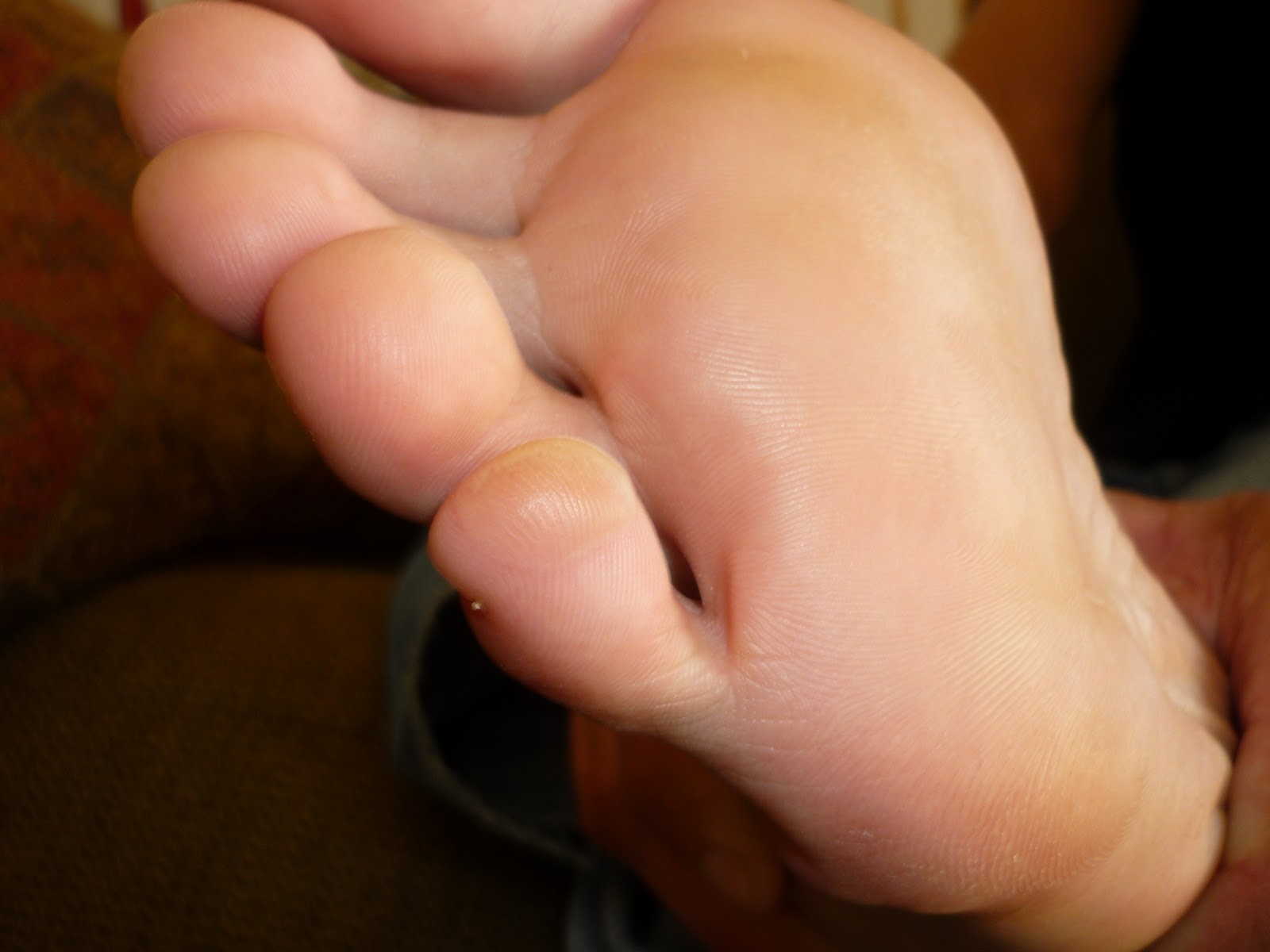
My first black toenail.


Not my first blister, but it might be my first blister that was bigger than the toe.
 

  I would like to point out that a tradition was broken: no medical tent. Instead I went to the food tent 
and ate pizza while a woman vomited in a trash can next to me.  Only at Ironman.


Some signs shouldn't be ignored.  


Stuck and probably very embarrassed.  They did a lot of damage.


10 pm on State Street cheering on the final finishers.


9.10.2010

Ready to go

 Here's an interesting site I heard about on IM Talk:
http://www.swimtypes.com/typesindex.html
 
It says I'm an over-glider.  Reading the description, it could be correct.  Interesting site.

**********

Still working on the spectator guide.  I finally found the website for the Q-sheet I use so I can create my guide.  It's pretty cool.  It's a spreadsheet someone created where you punch in your predicted time and it puts the time you should be in certain places on a map. I ordered it last night and I'm still waiting for them to e-mail it to me.  It should show up today.  They're pretty quick about that.  

I did my last real workout last night.  My legs have been very sore and sluggish all week.  I've been getting worried.  No more.  They're coming around quickly.  They're not 100% yet, but I kept putting out too much power on the bike and having to hold back which is a really good sign. 

The weather is looking pretty good, except it looks like it might be windy.  One site had wind gusts of up to 34 mph.  Wind could actually work to my advantage because I put a lot of time into aerodynamics, but I'd rather not deal with it. 

I picked up my packet yesterday so I'm all set to go.  It's all about race day now.

**********

As is typical of me I'm already looking past the race and planning next season.  After the race, I'm going to do two things I've never done - a run focus, and cross country races.  I discovered that college cross country races have an open class so I'm putting together a short cross country season.  I never ran cross country and it sounds like a lot of fun so I'm really looking forward to that.  Plus, I've never focused on running.  Since getting into triathlon I've always focused on improving my bike or swim and running has always been on the back burner so I really want to work on that and see if I can improve my running.  It will be a fun change of pace if nothing else.

And, I just discovered a race in Indiana in December I'm tempted to do.  The Huff 50K, a 33 mile trail run.  Could be interesting.  Last year they ran in a few inches of snow. 

9.08.2010

Kia Kaha

I'll be posting my spectator guide in a couple of days, which is mainly for my parents, but I've had a few friends ask for it again so they know when I might be coming through key spectator points.  But I haven't finished it yet, so hopefully I'll get that up tomorrow or Friday at the very latest.  The race is coming up quickly.  I'll also post the link to the athlete tracker.  I'm #877.

Registration starts tomorrow.  I was hoping to register over lunch tomorrow to get it over with, but a meeting got rescheduled at work and screwed up those plans.  Work always gets in the way of life.  It never fails.  So I'll register Friday unless I get a chance to sneak out of work early Thursday. 

Taper update:  It's going well, but I'm making last minute changes.  I want to trust all the numbers and blindly follow the plan, but numbers are only numbers.  They can't truly tell you how you feel, and right now I'm not feeling the way I think I should.  My legs are still heavy and sluggish and a little sore.  It's a tricky situation, because they felt worse yesterday yet I easily hit my numbers on my workouts.  But, I know it would be a huge mistake going into the race with tired legs so I'm scrapping my bike ride today.  It was just a recovery ride, but I think rest is better.  I'm still going to do my lunch run but I cut out the 10 minutes of tempo I had planned and I'm replacing it with two or three 20 second striders to get a small amount of intensity in the workout.  Then I'm going to go for a short swim after work.   To convert the changes back into numbers, I had 110 training stress points planned and cut it down to 50 (the bike was 50 points and the run was 60 so I cut 10 off of that).  I need around 110 to maintain my current training load ("fitness") so only doing 50 will mean that today is going to be well below my average training load so today easily qualifies as a recovery day and hopefully tomorrow my legs will start to come around and feel good.  


Tomorrow is a moderately hard day (85 training stress points) but not bad.  Friday is a rest day  and Saturday is a short race warm up so it's more or less a rest day as well.


Sunday is race day.  


For those of you doing the race, good luck.  Kia Kaha (stay strong).  Here's a quote I heard the other day to help get you (and me) through those tough spots:


"The body is evil and must be punished."


8.31.2010

Pushing the limits

We're less than 2 weeks away from race day, and with all my big training behind me I can't help but wonder if I'm ready.  I have set big goals for myself, and I question my ability to reach those goals. I'm filled with as much doubt as I am anticipation for the race to begin.

So.....am I ready?  I don't know.  I've got two iron distance races under my belt and even though I struggled with the heat in Florida last year I won my age group.  It was a different race, but winning my age group gives me a level of confidence that my goals aren't completely unrealistic.  Most importantly, I learned a lot from that race and if it's hot in WI this year I'll know how to handle it.

My training began on Jan 4th and since then I've trained for more than 500 hours.  I swam more than a quarter of a million yards, ran more than a thousand miles and biked more than five thousand miles.  My longest swim was 3.6 miles, my longest bike was 132 miles and my longest run was 21.5 miles.  My longest brick was a one mile swim followed by a 112 mile bike followed by a 13 mile run. 

I got a bike fit and improved my position.  I also bought race wheels, new handlebars and a compact crank.  I learned more about using my powermeter and analyzing data.  I learned how to better distribute my power and what cadence is optimal for me to run well off the bike (I learned all this the hard way).  And I finally got my FTP above 300.

I nailed down my nutrition strategy and finally figured out exactly how much sodium I need.  I ran in the heat, the rain, the snow, the mud, the ice, thunderstorms, blizzards, etc.  I did hill repeats, tempo runs and track workouts.  

So am I ready?  I still don't know. 

A friend of mine asked me what I think about on a long swim, and my answer was that it varies.  I swam at Devil's Lake Sunday and thought about everything listed above.  I couldn't get it out of my head.  Am I aiming too high?  Am I strong enough?  Fast enough?  Did I train hard enough? 

What if I fail?

And then, out of the blue, I thought about the No Fear poster of Jeremy McGrath that hung above my bike back in my motocross days.  It said:

You must always push the limits.  Because if you never fail, you will never succeed. 


And suddenly I didn't worry about it anymore.  Looking back, I had a great year.  I had a lot of fun did a lot of racing.  I pushed myself and learned more about training for and racing triathlons.  All I can do at this point is race the best race I'm capable of and whatever happens happens.

I don't know if I'll fail or succeed, but I do know that on September 12 - while I won't be the fastest guy out there, or the strongest or most talented - I'll be the guy who refuses to stop pushing his limits.

No fear.

8.24.2010

It's NOT A Taper


It's that time of the training season....the dreaded taper.  I say that because it's the part of training most people fear (me included).  Screw up the taper, and you just screwed up a year of training. 

This year I'm taking a little different approach to my training and so far it's been paying off so hopefully I'll nail the taper and head into my 'A' race feeling well-rested and race ready (shred ready as a friend of mine used to say back in my motocross days). 

The first thing I'm doing is ditching the word taper.  I don't like it, mainly because it conjures up images of resting and relaxing and just sitting around waiting for race day.  That's how I've thought of tapers in the past, and the result is that I tapered too much and lost some fitness going into race day.  This year I'm calling it a sharpening period.  Yes, my training is tapering down so it's still a taper, but what I'm really doing is sharpening.  During a taper, your volume decreases and your intensity increases so you sharpen your skills and go into the race well rested and....well....sharp.  In my mind, "taper" makes me want to lay on the couch and "sharpening period" makes me want to workout but be very smart about it and make sure every workout is right on target.  

The other thing I'm doing differently this time around is relying more on the numbers.  What can I say?  I'm an analyst.  It's what I do.


But how do I use the numbers better this time than in the past?  That's the trick.  In the past I've focused mainly on weekly hours and tapering them down as suggested in the many books I've read.  That's all well and good, but I tapered too much for too long and while I felt great on race morning I wasn't as fit as I needed to be.  De-training had already begun.


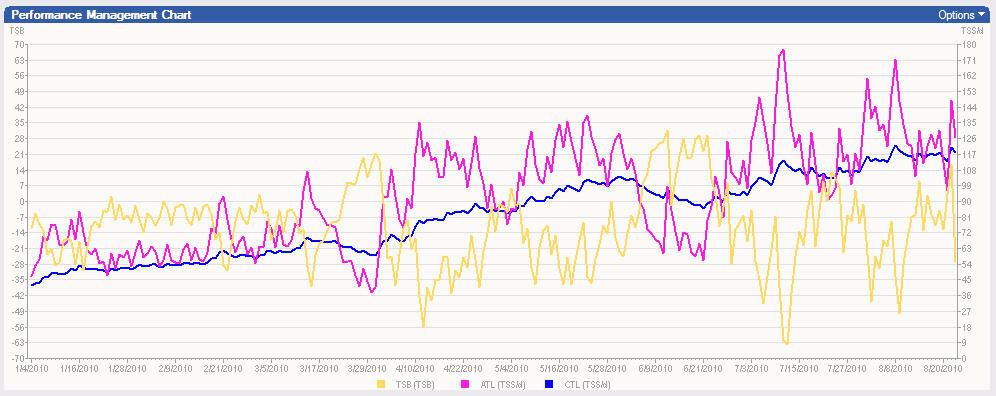
I'm going to try to explain this without making it too confusing (for my benefit as well as yours).  To start with, I use a piece of software called WKO+ to log all my workouts.  From there, I upload them to trainingpeaks.com which is what I use to schedule all my workouts and track my hours and mileage and all that jazz.  WKO+ is used for analyzing the data from the cycling and running workouts.  WKO+ assigns a Training Stress Score to each workout and with that score I'm able to track my fitness, fatigue and 'freshness' through a chart called the Performance Management Chart:


I know....a little confusing.  Basically, the blue line represents my fitness (it's based on the past 6 weeks of training) which has been steadily climbing all year as planned.  You can see where it dips in June, which is from my first 'A' race.  If it sounds weird that I would lose fitness doing a race, it's because I tapered for that race and rested/recovered for a week afterwards.  So my volume was pretty light for about 3 weeks so even though I raced I lost fitness because my training volume (training stress) dropped significantly.  Fitness disappears very quickly (I actually did notice the loss of fitness in my early workouts after the race - it wasn't a big loss but enough to make a few workouts disappointing).  It's frustrating how quickly fitness fades away.  


The pink line represents my fatigue.  It takes into account the past 7 days of training so when the pink line jumps up suddenly you can tell that was a period where I increased my volume suddenly (the big jump with the highest peak is the Endurance Nation Training Camp I did in early July - big volume that weekend).  The training load becomes heavy and you get tired.  Fatigue is especially bad when the pink line is well above the blue line.  Basically that means I'm training way above what I'm trained for since the blue line is my fitness and the pink line is my current training load.  

Yellow is the Training Stress Balance, the balance between the pink and blue lines.  It represents what they call 'freshness.'  As the pink line (fatigue) goes down, yellow goes up indicating I'm fresh and ready for a good workout or race.  

Now the tricky part...the sharpening period.  When you decrease your volume the blue line (fitness) is going to start decreasing.  You're losing fitness.  You do this in exchange for freshness, because your yellow line will begin moving up and pink (fatigue) will move down.  That sounds easy enough, but the trick is finding the right balance which is what I've screwed up in the past.  While you may think you want the yellow line as high as possible, you don't.  Too high a value is most likely an indication of lost fitness.  Likewise, you don't want the blue line to drop too much which is definitely a sign of lost fitness.

I've been reading a lot about sharpening periods lately and they say they work best when preceded by high training stress and when the volume drops off suddenly and exponentially.  Two to three weeks is what works best for long races such as marathons and ironmans.  I'm doing three weeks (this is week one) although my first week is still very high volume with big weekend workouts.  Week two and three is when the volume drops off suddenly, mainly week 3 which is race week.

So how did I screw this up in the past?  I rested too much.  Last year for Florida, my fitness (blue line) peaked 20 days before the race.  By race day it had dropped 19%.  Joe Friel (whose training philosophies I follow) recommends no more than a 10% drop.  I broke it down by discipline and the results made a lot of sense.  I rode well on the bike but felt more fatigue than expected late in the ride.  My bike fitness peaked 20 days before the race and dropped 22% by race day.  My running fitness dropped 15%.  

Yesterday was a really long brick and my numbers going into the workout were right where they should be and I had a great workout.  I felt great and never faded, although the sun bearing down on me did start to take its toll but there's not much I can do about the weather.

So what I've been doing is crunching the numbers and I planned my workouts over the next 3 weeks based on training stress score rather than hours.  I'm still watching my hours and those are right in line with the recommendations too, but I'm really focusing on making sure my training stress scores are where I need them.  

Based on that, my fitness will peak 14 days before the race and will drop 9% by race day.  My fatigue will decrease and fall below the blue line and my training stress balance (which Joe Friel recommends being between 10-20 - it's often a negative value - on race day) should be at 19 on race morning. My training stress balance for Florida was 31.4 and it was 31.5 for the Liberty Half Ironman earlier this year which I struggled at. 


Yes, I have a spreadsheet.


Although I didn't taper for my big brick this weekend, I did have a recovery week prior so my volume had dropped.  My fitness peaked 14 days before this workout and had dropped 10%.  My fatigue fell below the blue line to where it represented 75% of the value of the blue line (exactly where it will be on race morning) and my training stress balance was 16.5.  


Based on how well my brick went yesterday and where the numbers were going into it, the numbers I'm shooting for on race day make sense.


8.12.2010

IM Marathon Prediction Test

Last night I headed to the Verona High School track to do an ironman marathon time prediction test.  

It was a hot, humid night which I was happy about.  Not because I like the humidity, but because this test is a heart rate based test and I knew the heat and humidity would raise my heart rate and affect the test.  That may sound like a negative thing, but I was thinking that if I could hit the numbers I wanted on a hot, humid night, I'm set.  Plus, I think the increased heart rate from the heat more simulates the ironman because you run the marathon in the afternoon and you're already fatigued from the bike so your heart rate is going to be higher for a specific pace than it would be if you were fresh.

The first thing you need to do is set your heart rate zone.  There are two ways to do this.  The first way is to take your lactate threshold heart rate (your 5k heart rate) and multiply it by 82% and 88% to get your zone.  Doing that gives me 145 bpm for the bottom of the zone and 155 bpm for the top of the zone (my 5k heart rate is 177 bpm).  

The other way is to subtract your age from 180.  That's the bottom of the zone.  Add 10 beats and that's the top of the zone (I believe this comes from Phil Maffetone, not positive).  I'm 35 so 180-35 = 145.  Add 10 and I have a zone of 145-155.  Interesting that both ways came up with the exact same zone.  

The workout starts with a warm up. Then you run until you get your heart rate up to the bottom of your zone.  I find that it helps to do a full lap at that heart rate before beginning the test.  Otherwise your pace is off for that first lap.  

Then you run 6 laps at that heart rate - 145 bpm for me - and you record each split.  Here are mine:


2:00
1:58
1:59
1:58
2:00
1:59


Then you get your heart rate up to the top of your zone - 155 bpm for me - and run 6 laps at that heart rate and record your splits.


1:50
1:52
1:52
1:52
1:54
1:51


Then do a cool down and you're done.


What you do is take the numbers from your first set and figure out what your average pace was.  I ran the whole set in 11:54 which is a 7:56 pace.


Then take the second set and do the same.  I ran that in 11:11 which is a 7:27 pace.  


Then add 30 seconds to your second set pace.  That puts my second set at a 7:57 pace.  Then you take the two paces and average them together and that's your ironman marathon goal pace. 


I've been targeting an 8 minute pace for this whole year of training so coming up with a 7:57 pace on a hot, humid night for this test is very reassuring.  Of course, it's just a test and you have to compare it to other workouts to see if it's realistic because there are a lot of variables that can affect your ironman marathon.  But I've felt like my workouts lately have been indicating my 8 minute pace goal isn't out of line so this test gives me confidence.  


A general rule of thumb is that successful ironman athletes can hold a heart rate approximately 20 beats below their threshold.  That would mean I could hold 157 bpm, and I'm hoping to keep my heart rate below 150 on the run...definitely below 155.  I did a 21.5 mile run on Sunday at a 7:40 pace and had an average heart rate of 137.  That was in cool weather in the morning, but I think that run and this test shows that I'm on target.