I thought I'd give a quick update on my training before I leave for Cozumel tomorrow (yeah, last minute).
My training was quite a bit different from my Ironman build the past couple of years. I typically hit 20+ hours on my peak weeks, and for Wisconsin this year I topped out at over 30 hours on my solo MN training camp. For Cozumel, I maxed out at 17 hours. Intensity was higher, but overall hours were lower and so was my weekly TSS. It makes me a little concerned about my endurance, but I wanted to try something different.
Despite lower volume, I still did some big workouts. Three 5-hour rides, a 20-mile run, long swims, a 70-mile/16-mile bike/run brick, etc.
Some bike highlights:
I set a PR on one of my all-time favorite threshold workouts- Spinervals Timetrialapalooza.
I got in some high intensity, a workout I haven't done in years - Spinervals Suffer-o-rama.
I cracked in the last 45' interval on this ride, but still got in 5 solid hours.
For the first time in 2 years I was able to put in a solid block of running. My knee appears to finally be 100%. I never ran faster than 5K pace (other than some 20-second striders once a week), but the past two years my training has included almost no running faster than a 7:00 pace because my knee couldn't handle it. I changed things up and started following Daniels Running Formula and as a result, I took 25 seconds off my 5K PR. Some highlights:
A very solid M-pace run.
A good T-pace run.
Another good M-pace run.
Lake Geneva Turkey Trot - 3rd OA, 1st AG - Course was long, but I FINALLY ran a sub-6 pace (been chasing that for 4+ years).
As for swim training, I did several 4x1000 workouts at a 1:25 per 100 yard pace. My best ever is 4x1000 @ 1:24 pace and I've only done that once so I'm not far off that.
Overall, I feel like my training was pretty solid. The big surprise was my running which improved weekly. Typically, I'm all about the bike when approaching an Ironman but this time around I can't wait to get off the bike and run.
One of the biggest changes in my training this time around was mental. I was very relaxed about it all. I didn't put any pressure on myself to hit any pace or power goals. I took rest when I wanted/needed it. I never thought about a Kona slot. I just had fun with it. I still used training stress and the performance management chart in TrainingPeaks, but I didn't obsess over the numbers as much. I think I found a good mix of training by feel and training by the numbers.
As a result, I'm going into Cozumel with a very different attitude than Wisconsin. In Wisconsin, I put pressure on myself to qualify. I had to or the race was a failure. That's a bad attitude. This is supposed to be fun, an adventure.
So this time around it's all about fun. I just want to have fun, race hard and push my limits. If that gets me a ticket to the big island, great. If not, there are a lot of other races out there I'd like to do (I've been itching to focus on short course for a few years so maybe I'll go that route).
I'm well into race week and feeling much better than I did in race week before WI. My taper has been a lot different. It's a shorter taper, but has included a lot more rest. Menally, I wasn't ready to race Wisconsin. My legs were really sluggish race week and I was wishing I had more time to recover. This time around I can't wait for the gun to go off Sunday. I feel good and am itching to test myself. I hope that means I have a good race headed my way.
For anyone interested in tracking me, my number is 2404. You can go to www.ironman.com and then click on coverage and select Ironman Cozumel. They're in the central time zone. Race starts at 7 am.
We're staying at the Iberostar. I can't wait to get there.
11.22.2012
10.18.2012
A Cozumel Training Update
So
far I’m two weeks into my Cozumel training. I had three weeks of easy
training/recovery and now I’m well into my first build cycle. I thought
I’d write an update and talk about how it’s going and some of the changes I’ve
made.
Intensity
– I cut my hours and cranked up the intensity and so far I'm loving it and responding very well. I guess I
needed a change. Typically I’ve spent a lot of time riding tempo on the
bike and now I’m doing a lot more threshold and above threshold work. Last Tuesday I did
one of my staple threshold workouts, the Spinervals Timetrialapalooza DVD, and
hit numbers I’ve never really come close to before. This DVD has always
been a good indicator of threshold for me (the average power of all 4 intervals
combined is usually very close to my FTP) and this workout indicates my
threshold is up about 10 watts to 310. I've also done some very high intensity work. I’m being careful with the running
intensity. My hard workouts aren’t super intense, but they’re a lot more
intense than anything I’ve done in the past two years. I’ve basically
been racing on all easy base miles since 2010. Now I’m doing striders
once a week and one workout that’s either long M-pace or a 20’ T-pace interval. No track workouts yet. My swimming isn’t as strong as it
was early in the year so I have some work to do there, but I’ve cranked up the
intensity there as well.
Core
– I’m hitting the core work hard. Hopefully this will help with my
swimming, but it should also help with my running because I think weak
core/hamstring/glute muscles caused my injury and have been the cause of all my
hip flexor issues. Mainly the core work is injury prevention and to help
me maintain better form in the pool.
Efficiency
– Since I don’t have a lot of time to build fitness, and a lot of what I’m
doing is trying to get back to peak fitness, I’m putting a lot of emphasis on
efficiency. I figure if I can be just a little more efficient and put
more energy into forward motion, that could make a big difference over 140
miles. I’m working on running form/cadence. Prior to working
on cadence, my natural running cadence was about 82. Now I’m averaging 88
on my runs and my legs feel better and I’m running faster on less effort.
I’m putting a lot of emphasis on swimming form as well to improve my efficiency
there, and I’m also working in more efficiency training on the bike such as
one-leg drills and high cadence spinning on my recovery rides. It’s too
early to say if I’m gaining anything or if I will gain anything. I figure
it can’t hurt so I might as well give it a go.
Diet
– I'm going to write up another post on that because I've made a few changes and don't want to make this post too long. So far I'm 7 or 8 pounds lighter than I was at my IMWI weigh in.
Recovery
– I’ve already talked about this so I won’t beat it into the ground. I’m
giving myself more recovery and my easy days are ridiculously easy. I
don't think most people would enjoy riding with me on an easy day right now.
The pace is way too slow. Sometimes I just tip over on the bike path I’m
going so slow. I averaged 110 watts in my recovery ride the otherday. That’s about 37% of threshold. I did some single-leg drills and high
cadence spinning on that ride.
So that's my update. Lower hours, higher intensity, more recovery, less food....and PRs. I'm feeling good and really enjoying the training.
Next up is another IMWI power file analysis.
10.03.2012
Danger Danger!
I've got a couple of power files to dig through and post, but in the meantime I thought I'd share this picture a friend of mine posted on FB to show everyone how dangerous the area I'm living in is. I'm risking my life every day I train.
Read Aug 14.
I would love to know the thoughts that go through a person's head prior to calling the police on a squirrel.
If you're concerned about the mailbox on Aug 6, don't worry. It was found in the neighbor's yard. Perhaps the suspicious squirrel had something to do with that.
10.01.2012
Power File Analysis: IMWI '11 - Scott Roehrborn - KQ
A few posts ago, I asked for some power files to analyze and post. I received one from Scott Roehrborn, an ex-teammate of mine from the Gear Grinder team. It's from Ironman Wisconsin 2011, where he qualified for Kona.
To give you a little background on Scott, He's 40, 5'9" and 138 pounds. He has 20+ years of multisport experience with a running background going back to high school cross country and track. He's a self-coached athlete and this was his fifth Ironman, all of them being IMWI. His threshold is 235w.
There weren't a lot of surprises in his file. He did a great job pacing himself, as expected. Typically, when people qualify for Kona, their power files are great examples of pacing.
Scott's splits from the race:
Swim: 1:05:48
T1: 5:30
Bike: 5:28:03
T2: 2:42
Run: 3:25:18
Total: 10:07:21 (5th in AG)
Taking a quick look at his metrics from the ride, there are a few key things I want to point out. First off is that Scott rode at an Average Power that is 68% of his threshold and his intensity factor was .71. This is on the lower end of recommended zones for Ironman so Scott may have ridden more conservatively than he needed to and left a little time on the table, but that's hard to say for sure. I'd have to see the data on his big training rides because ultimately you need to decide how to ride on race day based on your long rides, plus he qualified for Kona by taking 5th in his age group so it's hard to say he didn't pace himself well. He clearly did. But I see potential for faster bike splits by riding at 72-75% of FTP and an IF of .75-.78. This depends on Scott's bike fitness and how confident he feels he can ride that hard for 112 miles and run well.
Another metric worth pointing out is his VI at 1.04. That's low for the Wisconsin course and a sign of very good pacing. This means he controlled his effort and didn't hit the hills too hard, but also kept his power up on the flats. Basically, he spent a lot of time right around his goal power. VI is NP/AP so you can see his Normalized Power and Average Power are very close.
Sidenote: I read a really good summary of what Normalized Power and Average Power is that I want to share: Normalized Power is how hard you worked, Average Power is how fast you went.
Scott's TSS is 279, which is good. A general rule of thumb is to try to keep it below 300. He burned almost 3200 calories and had a cadence of 93.
When looking at an Ironman power file, one place I like to start is the power zone distribution:
This is a great example of good pacing. Scott has the majority of his time in his endurance zone (51%) followed by tempo, recovery and very little time at threshold and above. You can get away with more time in the tempo zone, but that depends on your strengths and weaknesses. Strong cyclists will be able to push closer to the top end of the endurance zone and will end up with more time in their tempo zones. This power distribution looks really good.
This is his power distribution broken down into 20 watt zones. A few things to point out - the tallest bar is 160-180w. Scott spent nearly two hours right in that zone, so nearly 36% of the right was right at Ironman power. Another thing that stands out is the 0-20w bar - that's time spent coasting. Scott spent 18 minutes coasting, only 5.5% of the ride. One last thing to point out is how quickly the bars drop off to the right of the tallest bar. This shows little time spent around and above threshold. This is where his low VI came from - very few hard efforts, very little coasting, lots of time right at goal power.
I always like to create this chart, which just shows all time spent above threshold. For Scott, that came to less than 10 minutes. That's very good for a course like Wisconsin with all the short, steep climbs. This shows a lot of patience and discipline on Scott's part.
In the chart above, blue is power, red is threshold, green is the power trendline. Here you can easily see how little time Scott spent above threshold and how he doesn't have any sustained efforts at or above threshold. His power trends downward slightly, which isn't bad. That's pretty typical. You can see he basically maintained even power throughout the entire ride.
If you're unfamiliar with Quadrant Analysis, the horizontal line is Scott's threshold. The vertical line is threshold cadence. The line you need to be most concerned with here is the horizontal line, the division between quadrants I&II and III&IV. It might be hard to read, but the big thing to point out in the quadrant analysis is how little time Scott spent in quadrants I and II (the top two quadrants). Those two quadrants really zap your strength and glycogen. For an Ironman, you want your power in quadrants III and IV. The way to accomplish this is to limit your time above threshold (recurring theme if you haven't picked up on that yet :)
Nutrition: I always like to take a look at nutrition because I think one of the big advantages of having a power meter is that you get accurate calorie information (KJ = Calories burned). A lot of people get hung up on calories vs. body weight or how many calories they think they can take in per hour, etc. I like to compare calories taking in vs. calories burned. I've had good luck replacing around 40% of calories burned. (Gordo Byrn recommends replacing 50% of calories burned). Scott took in 1400 total calories on the bike (250 per hour), which was a mix of Carbo Pro and 4 Espresso gels with caffeine. He burned 3,176 calories so he replaced about 44% of the calories he burned.
Overall, this file is a great example of how to pace yourself well and set up a good run. Obviously, it takes a certain level of fitness to KQ, but one of the biggest keys to qualifying is proper pacing on the bike. A lot of people throw their races away in the first two hours on the bike because they lack the discipline and patience to hold back. Scott held back and was rewarded with a ticket to the big island.
One last sidenote: Scott rode a 50/34 compact crank with a 12/27 cassette and said it was perfect (I ride a 50/34 compact with 11-25 cassette).
Scott is racing Kona in a couple of weeks, and if he can pace himself this well again I think he'll have a good race. Good luck in Kona, Scott. Thanks for sharing your power file.
To give you a little background on Scott, He's 40, 5'9" and 138 pounds. He has 20+ years of multisport experience with a running background going back to high school cross country and track. He's a self-coached athlete and this was his fifth Ironman, all of them being IMWI. His threshold is 235w.
There weren't a lot of surprises in his file. He did a great job pacing himself, as expected. Typically, when people qualify for Kona, their power files are great examples of pacing.
Scott's splits from the race:
Swim: 1:05:48
T1: 5:30
Bike: 5:28:03
T2: 2:42
Run: 3:25:18
Total: 10:07:21 (5th in AG)
![]() |
| Metrics from IMWI '11 |
Taking a quick look at his metrics from the ride, there are a few key things I want to point out. First off is that Scott rode at an Average Power that is 68% of his threshold and his intensity factor was .71. This is on the lower end of recommended zones for Ironman so Scott may have ridden more conservatively than he needed to and left a little time on the table, but that's hard to say for sure. I'd have to see the data on his big training rides because ultimately you need to decide how to ride on race day based on your long rides, plus he qualified for Kona by taking 5th in his age group so it's hard to say he didn't pace himself well. He clearly did. But I see potential for faster bike splits by riding at 72-75% of FTP and an IF of .75-.78. This depends on Scott's bike fitness and how confident he feels he can ride that hard for 112 miles and run well.
Another metric worth pointing out is his VI at 1.04. That's low for the Wisconsin course and a sign of very good pacing. This means he controlled his effort and didn't hit the hills too hard, but also kept his power up on the flats. Basically, he spent a lot of time right around his goal power. VI is NP/AP so you can see his Normalized Power and Average Power are very close.
Sidenote: I read a really good summary of what Normalized Power and Average Power is that I want to share: Normalized Power is how hard you worked, Average Power is how fast you went.
Scott's TSS is 279, which is good. A general rule of thumb is to try to keep it below 300. He burned almost 3200 calories and had a cadence of 93.
When looking at an Ironman power file, one place I like to start is the power zone distribution:
![]() |
| Power Zone Distribution |
This is a great example of good pacing. Scott has the majority of his time in his endurance zone (51%) followed by tempo, recovery and very little time at threshold and above. You can get away with more time in the tempo zone, but that depends on your strengths and weaknesses. Strong cyclists will be able to push closer to the top end of the endurance zone and will end up with more time in their tempo zones. This power distribution looks really good.
![]() |
| Power Distribution By 20w Zones. |
This is his power distribution broken down into 20 watt zones. A few things to point out - the tallest bar is 160-180w. Scott spent nearly two hours right in that zone, so nearly 36% of the right was right at Ironman power. Another thing that stands out is the 0-20w bar - that's time spent coasting. Scott spent 18 minutes coasting, only 5.5% of the ride. One last thing to point out is how quickly the bars drop off to the right of the tallest bar. This shows little time spent around and above threshold. This is where his low VI came from - very few hard efforts, very little coasting, lots of time right at goal power.
![]() |
| Time Spent Above Threshold |
I always like to create this chart, which just shows all time spent above threshold. For Scott, that came to less than 10 minutes. That's very good for a course like Wisconsin with all the short, steep climbs. This shows a lot of patience and discipline on Scott's part.
![]() |
| Power With Threshold and Trend Line |
| Quadrant Analysis |
If you're unfamiliar with Quadrant Analysis, the horizontal line is Scott's threshold. The vertical line is threshold cadence. The line you need to be most concerned with here is the horizontal line, the division between quadrants I&II and III&IV. It might be hard to read, but the big thing to point out in the quadrant analysis is how little time Scott spent in quadrants I and II (the top two quadrants). Those two quadrants really zap your strength and glycogen. For an Ironman, you want your power in quadrants III and IV. The way to accomplish this is to limit your time above threshold (recurring theme if you haven't picked up on that yet :)
Nutrition: I always like to take a look at nutrition because I think one of the big advantages of having a power meter is that you get accurate calorie information (KJ = Calories burned). A lot of people get hung up on calories vs. body weight or how many calories they think they can take in per hour, etc. I like to compare calories taking in vs. calories burned. I've had good luck replacing around 40% of calories burned. (Gordo Byrn recommends replacing 50% of calories burned). Scott took in 1400 total calories on the bike (250 per hour), which was a mix of Carbo Pro and 4 Espresso gels with caffeine. He burned 3,176 calories so he replaced about 44% of the calories he burned.
Overall, this file is a great example of how to pace yourself well and set up a good run. Obviously, it takes a certain level of fitness to KQ, but one of the biggest keys to qualifying is proper pacing on the bike. A lot of people throw their races away in the first two hours on the bike because they lack the discipline and patience to hold back. Scott held back and was rewarded with a ticket to the big island.
One last sidenote: Scott rode a 50/34 compact crank with a 12/27 cassette and said it was perfect (I ride a 50/34 compact with 11-25 cassette).
Scott is racing Kona in a couple of weeks, and if he can pace himself this well again I think he'll have a good race. Good luck in Kona, Scott. Thanks for sharing your power file.
9.28.2012
The Return Of The Recovery Week
No one has recovery dialed like that cat.
I mentioned in my posts about my Cozumel plan that I want to focus more on recovery, then I said my new plan isn't going to have any recovery weeks. My goal was to go with a more moderate build and include more rest within the weeks.
I picked up the new issue of Triathlete Magazine and there was a qualify for Kona 7-week training plan. I looked it over, but couldn't quite get a handle on how hard it was. It looked like there were a lot of big days, but big days aren't necessarily hard days if the intensity isn't high.
I decided to open up the spreadsheet I said was getting shut down for the next 3 months. (That didn't last long)
I plugged in an estimated training stress for each workout in that plan so I could see the training load per week. Then I graphed it...
![]() |
| Triathlete Magazine Kona Plan TSS Per Week |
Two big weeks, one recovery week, two big weeks and a taper. Then I wondered how that compared to what I did in 2010. I feel like I really nailed that taper/race...
![]() |
| Triathlete Magazine Plan compared to my IMWI 2010 build/taper. |
Interesting. I didn't expect them to line up so closely. This got me thinking. What does 2012 look like compare to these two....
![]() |
| Triathlete Magazine plan compared to 2010 and 2012 build/taper. |
Again, a similar shape, but the big difference is that easy week one month out. Volume that week drops off a bit in 2012, but not nearly as much. There's also a dip in training stress in 2012 in week 5 but that wasn't planned. That was fatigue forcing me to cut my long run really short that week. Otherwise it would have a similar shape to the taper.
I couldn't resist and plugged in my TSS for my Cozumel plan to see how that compared...
![]() |
| Triathlete Magazine, 2010 & 2012 IMWI and Cozumel Plan |
The chart starts to get busy, but you can see my Cozumel plan is very flat. No really big weeks, but no recovery week.
The wheels kept spinning....how important is that recovery week one month out? Or recovery weeks in general?
I started digging through my old training logs looking for patterns. I've done this before, looking for a repeatable, predictable pattern that led to great workouts and avoided bad workouts. I always focused on how quickly my training load was ramping up each week, but this time I took a different approach and looked at the training load per week and for the first time I started to see some patterns.
I have historically had some of my best workouts in the first two weeks after a recovery week. Week 3 is a little more hit or miss and anything beyond that gets sketchy. A lower training load and I can sustain it longer, but there's still a point where workouts suffer. I started to see what appeared to a be a grey zone in terms of training load per week. You always read about grey zones in regards to intensity, but not much on weekly training loads.
It seems like there's a zone where I'm not really doing enough to build fitness, yet I'm doing too much to truly recover. Some of my best workouts have come during big training blocks that were separated by a very easy week. Training blocks that came after recovery weeks that fell into that grey zone weren't as good. Even blocks that were all in the grey zone but had no big weeks eventually fell flat. It just took a little longer.
It appears, at least for me, that the recovery week really does serve a purpose. I think it becomes especially important close to an Ironman when you have some big days/weeks. Earlier in the year when volume is more manageable, I think you can go longer before stepping it back.
So I decided to bring back the recovery week. I tweaked my plan a bit and now have a 3-week build, a recovery week, two big weeks and a taper...
![]() |
| New Cozumel plan compared to Triathlete Magazine plan and IMWI 2010. |
I'm also working on building more recovery into each week. One big change is my running program. I'm basing my training on Jack Daniel's book this time and I'm doing a lot more short 30 minute runs. The past two years my short runs have been 45 minutes, but slower than my 30 minute runs are going to be. I also ran 5 times per week and now I'm going to run 6. I'll also be focusing on improving my run cadence.
Another change is my recovery rides. They've been getting too long and I don't think they're serving their purpose. They're too long to truly let me recover, but not hard enough to build fitness. So now they're very short and very easy.
I'm also focusing on losing some weight, improving my day-to-day nutrition and coming up with a better nutrition/hydration plan for race day. Mine works now, but I want to simplify it a bit so it's easier to remember. I do really well sticking to the plan in training but tend to wing it a bit on race day.
So now with all my Cozumel training plan posts, I'm sure I have everyone so confused they have absolutely no idea what I'm doing. Fortunately for me, it's all in Training Peaks and a spreadsheet or I'd probably be just as confused. :)
9.26.2012
Looking For Power Files
I enjoy digging through power files and analyzing them, so I thought I'd throw this out there....
If anyone has a power file from a race and you don't mind sharing it, I'd love to get some files to dig through and post my analysis of them on my blog. You could remain anonymous if you want, or I could post a link to your results from the race and a link to your blog if you have one. Either way works for me.
I'd prefer Ironman files, although halfs would probably be good too. Analyzing short races gets tough because pacing isn't as big of an issue. I'm not asking for any money, just some files. It will be a learning opportunity for me, and you'll get another perspective on your race.
If you're interested, shoot me an email at mdwolfgram146 at gmail dot com.
9.24.2012
Applying The "Basic Month"
I apologize if you find these posts about my training plan long and boring. I have to put the plan together so I figured why not do it on my blog (which I've largely ignored all year) and just throw it out there for everyone to see.
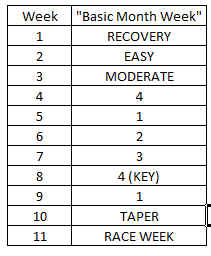
To apply my new "Basic Month," I started by working backwards from race day. Wisconsin and Cozumel are 11 weeks apart so it's just short of 3 full months. I want my key workout 3 weeks out from race day, and I think it fits best in week 4 of the "Basic Month" so that's where I'm starting from. I place week 4, then add in race week, taper week (two week taper) and fill in the rest. It now looks like this:
Now that I have that established, I need to chop some of it off to allow for recovery from IMWI.
Next I apply the "Basic Month" and make a few tweaks to it (mainly adding in recovery from IMWI and here's what I have so far (the first Monday on this is the day after IMWI):
That's my basic outline right now. For my key workout 3 weeks out from race day, I decided to cut out an intensity day and put the key brick on Saturday. Sunday will be an easy day, perhaps a good day to ride with some friends and grab a cup of coffee somewhere. One of the mistakes I made with my IMWI build was not giving myself enough easy days before and after my key workouts. For 2010 my structure looked a lot like this and that worked well.
My final hard bike on the Saturday before the race will be a threshold test plus a some additional suffering. The StravaJava team is getting geared up to try and reclaim our title at the 24-hour indoor TT that weekend. My plan will be to try and talk the team into giving me an early morning slot that day. I'll hammer out an hour and then hop on the trainer and do some time at IM power. It should be hot and humid in there, perfect training for Cozumel. I did a similar workout a few weeks before IMWI 2010 that included the 40K State TT Championships followed by several 30K "TTs" at IM power. It was a great workout.
*****
I didn't do this exercise for my 2012 IMWI plan. I mapped it out in my fancy schmancy CTL spreadsheet. It wasn't this colorful. It was a lot of numbers. Seeing the plan laid out in color like this is kind of nice. I see a fair amount of blue. I suspect if I were to go back and convert my IMWI plan to something like this I would see tons of orange and green, some blue, some purple and no red. I haven't done much high intensity the past few years. I've done tons of long, hard workouts.
My next step is to set some benchmarks I'd like to hit before the race. Then I need to dig in and add the details, the specifics, the workouts. That's time consuming, but not that difficult. I keep it simple. I'll come up with a small handful of workouts and repeat them over and over and over. I keep my workouts pretty simple too. To quote Joel Filliol, "Variety is for the weak-minded, and interferes with the learning process."
*******
I think I'll probably go through an exercise like this for next year's plan. Courtney laughs at me and thinks I'm just dazzled by all the puuuuurty colors, which may be true, but seeing it visually instead of numerically is giving me a better grasp of the overall plan - where the intensity is and isn't and where the fatigue is likely to be. The numbers are supposed to be good for that, but you can't turn Ironman training into a math problem...as much as I'd like to.
To apply my new "Basic Month," I started by working backwards from race day. Wisconsin and Cozumel are 11 weeks apart so it's just short of 3 full months. I want my key workout 3 weeks out from race day, and I think it fits best in week 4 of the "Basic Month" so that's where I'm starting from. I place week 4, then add in race week, taper week (two week taper) and fill in the rest. It now looks like this:
![]() |
| After Placing Key Workout and Taper |
Now that I have that established, I need to chop some of it off to allow for recovery from IMWI.
![]() |
| Adding Recovery from IMWI |
Next I apply the "Basic Month" and make a few tweaks to it (mainly adding in recovery from IMWI and here's what I have so far (the first Monday on this is the day after IMWI):
![]() |
| The First 5 Weeks |
![]() |
| The Final 6 Weeks |
That's my basic outline right now. For my key workout 3 weeks out from race day, I decided to cut out an intensity day and put the key brick on Saturday. Sunday will be an easy day, perhaps a good day to ride with some friends and grab a cup of coffee somewhere. One of the mistakes I made with my IMWI build was not giving myself enough easy days before and after my key workouts. For 2010 my structure looked a lot like this and that worked well.
My final hard bike on the Saturday before the race will be a threshold test plus a some additional suffering. The StravaJava team is getting geared up to try and reclaim our title at the 24-hour indoor TT that weekend. My plan will be to try and talk the team into giving me an early morning slot that day. I'll hammer out an hour and then hop on the trainer and do some time at IM power. It should be hot and humid in there, perfect training for Cozumel. I did a similar workout a few weeks before IMWI 2010 that included the 40K State TT Championships followed by several 30K "TTs" at IM power. It was a great workout.
*****
I didn't do this exercise for my 2012 IMWI plan. I mapped it out in my fancy schmancy CTL spreadsheet. It wasn't this colorful. It was a lot of numbers. Seeing the plan laid out in color like this is kind of nice. I see a fair amount of blue. I suspect if I were to go back and convert my IMWI plan to something like this I would see tons of orange and green, some blue, some purple and no red. I haven't done much high intensity the past few years. I've done tons of long, hard workouts.
My next step is to set some benchmarks I'd like to hit before the race. Then I need to dig in and add the details, the specifics, the workouts. That's time consuming, but not that difficult. I keep it simple. I'll come up with a small handful of workouts and repeat them over and over and over. I keep my workouts pretty simple too. To quote Joel Filliol, "Variety is for the weak-minded, and interferes with the learning process."
*******
I think I'll probably go through an exercise like this for next year's plan. Courtney laughs at me and thinks I'm just dazzled by all the puuuuurty colors, which may be true, but seeing it visually instead of numerically is giving me a better grasp of the overall plan - where the intensity is and isn't and where the fatigue is likely to be. The numbers are supposed to be good for that, but you can't turn Ironman training into a math problem...as much as I'd like to.
Subscribe to:
Posts (Atom)