In my last post, I talked about the swim video I got so I could analyze my form and figure out some areas to focus on in the off-season. I identified 3 things I want to focus on: not over-rotating, improving my catch and improving my kick.
Identifying problems is one thing. Fixing them is another. To start, I broke my training into three phases...
Phase 1 - Form phase. This is about 2 months long and the focus is form. All short repeats (less than 200 yards) with longer rest periods. Lots of kicking.
Phase 2 - Base phase. About 3 months. Higher volume, less form work but still working on form. Repeats will be a little longer, but still mostly short intervals. Rest intervals will tighten a bit. Not as much kicking.
Phase 3 - Race specific phase. This goes through the race season. Trying to maintain gains made in phases 1 and 2 but lowering volume to increase bike/run volume. Maintaining speed but adding in more endurance work and some longer repeats and open water work. Rest intervals tighten up a bit more.
I also bought a few new swim toys to help me work on form....
Ameo Powerbreather Snorkel. I've read about the benefits of training with a snorkel many times - mainly, by eliminating the need to turn your head to breathe, you can focus on other aspects of your stroke like the catch, symmetry, body roll, head position, etc. I bought a center-mount snorkel a few years ago but didn't like it so I never used it. Slowtwitch wrote about the Powerbreather recently and it sounded like an improvement over the center-mount snorkel so I ordered one. They're also good for kick sets. I'll be using this a lot in phase 1 as I work on form then I'll use it mainly in my warm up and cool down to continue working on form.
Finis Alignment Kickboard. No more kick sets with my head above the water practicing bad body position. This board forces you into a streamlined position so you're kicking with good form. It works best if you have a snorkel so you don't have to lift your head to breathe. This will get a lot of use in phase 1 as I focus on my kick.
Fins. To work on ankle flexibility and strengthening my kick.
Finis Tempo Trainer. I love this thing. I use it for pacing and stroke rate sets. I probably won't use this until phase 2 and definitely in phase 3.
So those are my training phases and the swim toys/aids I'll be using. I plan on getting video a few times if possible to make sure I'm making progress with the form work. I'm also thinking about signing up for a few masters swim meets this winter for motivation.
To test my progress I'll be doing the occasional 1000 yard time trial. I've done those in the past, so I have prior times to compare.
I started my swim phase with video last week and then a few days working on form with the snorkel and kick board. A few days ago I did my first 1000 yard time trial to set my bench mark. I surprised myself by swimming it in 13:17, which is a 2 second PR. I was expecting something closer to 13:40 - 13:50. It's a good surprise, but it makes me wonder. Did I improve already? If not, why have I been swimming some of my slowest open water times in years this season if I'm capable of a 1000 yard PR?
I suppose it doesn't matter. All I can do now is focus on improving my swim in the pool and then try to make that speed transfer to the open water next year, which has been a challenge for me in prior years.
10.24.2016
10.18.2016
Swimming: Suck Less in '17
If you want to improve your swim, get some video. Seriously. The last time I got video was late 2011 when I did a swim focus that off-season. That was the last time I made progress in my swim. It's actually gone backwards a bit the past couple of seasons.
To start my off-season, Courtney went to the pool with me to get some video with the GoPro. My plan was to analyze the video using Kinovea (great, free software for analyzing video, measuring angles, going frame by frame, etc.) and find two or three big form flaws to work on. I don't want to try and work on too many things at once.
I watched a great webinar from USA Swimming on rotation so that was on my mind when analyzing the video. I over-rotate, especially when I turn to my right to breathe. I'm not as bad as I used to be - I used to rotate almost completely on my side - but I'm still over-rotating. I'm starting my pull with my left arm too soon and I'm rotated too much. Then when I rotate back to my stomach, my arm is pulling under my body, which is not an effective pull. You can see it very clearly on the right image above from 2011. The one on the left is from 2016. It's better, but I'm still missing out on a lot of my pull by over-rotating. My hand should be below my shoulder like the image below.
Above is an image from the webinar showing good rotation (about 30-35 degrees) and a good catch.
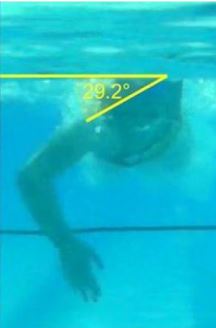
This is me. I'm rotated too much, about 60 degrees. Because of that, I can't get my arm in the same position as the pic above. I don't have shoulder flexibility like that (who does?). My arm is too deep and my catch isn't very effective....and this is my right arm, my good arm.
Above is a shot from the webinar showing a bad catch on the left and a good catch on the right. I'm much closer to the image on the left. The good news is that those images are of the same person 6 months apart. There's hope.
So that's 2 things: rotation and catch. The third thing I found that I want to address is my kick. It's actually come a long way since I started, but I still have some work to do.
Your kick is supposed to be tight. You shouldn't bend your knee that much. I'm creating a ton of drag doing that. I suspect it might be related to my over-rotation. I think I'm kicking my leg out to the side for balance, so if I can minimize my rotation I think my kick may start improving as well.
So those are the three big things I've decided to work on immediately. I'm not going to worry about any other form flaws until I improve those three things. I think, if I can improve those, I'll make some good progress.
It's one thing to find issues. It's another to address and fix them. In my next post I'll go over my plan to make improvements and my new swim toys I think might help.
To start my off-season, Courtney went to the pool with me to get some video with the GoPro. My plan was to analyze the video using Kinovea (great, free software for analyzing video, measuring angles, going frame by frame, etc.) and find two or three big form flaws to work on. I don't want to try and work on too many things at once.
![]() |
| 2016 on the left. 2011 on the right. My left arm has improved, but still a lot of work to do. |
I watched a great webinar from USA Swimming on rotation so that was on my mind when analyzing the video. I over-rotate, especially when I turn to my right to breathe. I'm not as bad as I used to be - I used to rotate almost completely on my side - but I'm still over-rotating. I'm starting my pull with my left arm too soon and I'm rotated too much. Then when I rotate back to my stomach, my arm is pulling under my body, which is not an effective pull. You can see it very clearly on the right image above from 2011. The one on the left is from 2016. It's better, but I'm still missing out on a lot of my pull by over-rotating. My hand should be below my shoulder like the image below.
| An image from the webinar showing good rotation. |
Above is an image from the webinar showing good rotation (about 30-35 degrees) and a good catch.
![]() |
| Me. Rotating too much. Arm is too deep. Not a good bend in elbow. |
| Another shot from the webinar. |
So that's 2 things: rotation and catch. The third thing I found that I want to address is my kick. It's actually come a long way since I started, but I still have some work to do.
![]() |
| Look at my left leg. That's a lot of drag. |
So those are the three big things I've decided to work on immediately. I'm not going to worry about any other form flaws until I improve those three things. I think, if I can improve those, I'll make some good progress.
It's one thing to find issues. It's another to address and fix them. In my next post I'll go over my plan to make improvements and my new swim toys I think might help.
10.14.2016
Starting to plan my off-season
I'm still working on my race schedule and goals for 2017, but in the meantime I've been working on my off-season plan. 2017 will be my 10th year in triathlon. I'd like it to be a good one, so I need a good plan for the off-season to address my limiters and take care of the things I feel have been holding me back...
Swimming
My swim was never strong, but it has gotten worse since my back injury. I'm not sure what the deal is exactly, but I think a lot of it has to do with my left leg (that's the one that was numb for several months when I was injured). That calf still cramps when I swim and I think that leg has a really weak kick right now and I suspect I'm not pointing my toes on that leg so that foot is creating drag.
Other than calf cramps, I'm tired of giving up big chunks of time in the swim and playing catch up the rest of the race. It's time to make some improvements.
Weights
This is mostly related to my injury, but also I think hitting the weight room this year will be good for me. I think my back injury created some big imbalances that I need to address. My plan is to do some light lifting to build a bit of a foundation and then do an 8-week block of heavy lifting to build strength. Then I want to dial it back to a maintenance routine that I'll continue through 2017. I also plan on working in some plyometrics and speed and agility drills. I think those will be a good change of pace, and that stuff can be fun. Also, core work will be a big part of my weights routine.
Diet
My diet has gotten worse over the past few years. I've gotten lazy and have lost a lot of the variety I used to have in my diet, and Ironman training has never been good for my diet. I want to clean up my diet, cut out the sugar, add more variety and then see if I can keep that going throughout the season next year. This will be the toughest change for me to make.
Running
Running hard after my injury caused issues so I haven't done much intensity the past two seasons. I think I've gotten to a point where I can handle higher intensity, and making sure I can handle more intensity will be a huge focus for me in the off-season. I want to do track workouts again, run 5Ks, etc. I'm thinking about doing a block of 5Ks this fall and maybe doing some indoor track workouts over the winter like I did several years ago. I set a goal of breaking 30 minutes at Crazylegs back in 2008. The closest I've come is 30:36 in 2013 so I'd really like to focus on that and see if I can finally check off that goal.
Yoga
I felt like yoga helped me a lot last year so I want to get back into it and hopefully continue doing some yoga throughout the season next year.
Cycling
Last on the list because it won't be a focus this off-season. I'm going to back off for a while and focus on other things. That's a risk because it's my strength, but I'm banking on it coming back quickly. I'd still like to improve my threshold a bit for next season, but I have more to gain in the pool and on the run so I'm going to focus on that for a while. I've never felt like a very complete triathlete with my bike usually ranking much higher than my swim and run so for my 10th year in the sport I'd like to finally become a more complete triathlete.
So those are the general things I want to work on. Now I need to spend some time figuring out my plan, and then I need to execute that plan. It's one thing to say I want to improve my swim (or whatever), it's another to actually pull it off. To do that, I need to have a plan. I'll post more details once I get them figured out.
Swimming
My swim was never strong, but it has gotten worse since my back injury. I'm not sure what the deal is exactly, but I think a lot of it has to do with my left leg (that's the one that was numb for several months when I was injured). That calf still cramps when I swim and I think that leg has a really weak kick right now and I suspect I'm not pointing my toes on that leg so that foot is creating drag.
Other than calf cramps, I'm tired of giving up big chunks of time in the swim and playing catch up the rest of the race. It's time to make some improvements.
Weights
This is mostly related to my injury, but also I think hitting the weight room this year will be good for me. I think my back injury created some big imbalances that I need to address. My plan is to do some light lifting to build a bit of a foundation and then do an 8-week block of heavy lifting to build strength. Then I want to dial it back to a maintenance routine that I'll continue through 2017. I also plan on working in some plyometrics and speed and agility drills. I think those will be a good change of pace, and that stuff can be fun. Also, core work will be a big part of my weights routine.
Diet
My diet has gotten worse over the past few years. I've gotten lazy and have lost a lot of the variety I used to have in my diet, and Ironman training has never been good for my diet. I want to clean up my diet, cut out the sugar, add more variety and then see if I can keep that going throughout the season next year. This will be the toughest change for me to make.
Running
Running hard after my injury caused issues so I haven't done much intensity the past two seasons. I think I've gotten to a point where I can handle higher intensity, and making sure I can handle more intensity will be a huge focus for me in the off-season. I want to do track workouts again, run 5Ks, etc. I'm thinking about doing a block of 5Ks this fall and maybe doing some indoor track workouts over the winter like I did several years ago. I set a goal of breaking 30 minutes at Crazylegs back in 2008. The closest I've come is 30:36 in 2013 so I'd really like to focus on that and see if I can finally check off that goal.
Yoga
I felt like yoga helped me a lot last year so I want to get back into it and hopefully continue doing some yoga throughout the season next year.
Cycling
Last on the list because it won't be a focus this off-season. I'm going to back off for a while and focus on other things. That's a risk because it's my strength, but I'm banking on it coming back quickly. I'd still like to improve my threshold a bit for next season, but I have more to gain in the pool and on the run so I'm going to focus on that for a while. I've never felt like a very complete triathlete with my bike usually ranking much higher than my swim and run so for my 10th year in the sport I'd like to finally become a more complete triathlete.
So those are the general things I want to work on. Now I need to spend some time figuring out my plan, and then I need to execute that plan. It's one thing to say I want to improve my swim (or whatever), it's another to actually pull it off. To do that, I need to have a plan. I'll post more details once I get them figured out.
10.11.2016
Race Report: Ironman Louisville
Ironman Louisville was my 9th Ironman since 2008 and my second Ironman of 2016. I changed up my training a bit from prior Ironmans and did a little more volume than I ever have leading into my taper 3 weeks out, and then did less volume than I typically do leading into a race. I wanted to be very fit, but also well-rested and ready to race. I think in the past I've done too much work too close to race day and carried some fatigue into the race and I didn't want to repeat that mistake again. I think this plan worked out well as my legs felt strong on race day.
Swim - 1:05:04
The Louisville swim is a time trial start. I didn't feel like getting up really early to try and get to the front of the line so I slept in a bit until 4:45 and got to transition about 6. Fortunately there wasn't any traffic and the lots across from transition were open so getting to transition was really easy. Since I got there a little later, transition wasn't busy so I got my stuff done and got in line only to find out, to my surprise, that the line was all the way back to transition (about a mile long). Wow.
So we waited....and waited...and waited....
I finally got in the water about 8:10, 40 minutes after the first swimmer. The swim was pretty uneventful. I had very little contact and just focused on my own swim. I didn't get any cramps like Texas, which was a good sign, but my left calf did threaten to cramp several times (an on-going issue since my back injury so I expected it). I predicted a swim time of 1:05 so I was happy to see a 1:05 on my watch when I got out of the water.
T1 - Since I started late, transition was packed. There was a line to get in the tent so I emptied my bag outside the tent and put on my helmet, grabbed my bike shoes, put my wetsuit in my bag and then plowed my way through the change tent to get to the bike racks.
Bike - 5:07:18
I loved the Louisville bike course. It was really crowded the first 30 (ish) miles, and cold, which sucked, but the course itself is awesome. It's challenging enough to be a fair course, but it's not that hilly and still fairly fast and the road conditions are really good. The roads are narrow and I got held up by cars about 6 or 7 times which was a new and frustrating experience. I've never been held up by traffic in an Ironman before.
I trained to hold about 210-215 watts but decided to go conservative to see if I could really nail the run so I held about 205 the whole way. I dialed it back on the way back into town and I think my final average power was 203. I had predicted a 5:05-5:10 split so I was right in line with that. The best part was that for the first time ever in an Ironman, I had to pee on the bike...twice actually. And my legs felt strong coming off the bike. They haven't felt this good at the end of the bike since 2010, and with the perfect weather I was in a good mood and looking forward to the run.
T2 - I got through T2 pretty quickly except I had to pee again so I stopped to do that so my T2 time wasn't very fast. I had estimated about 10 minutes for both transitions combined and that's where I ended up so still right on target.
The run - 4:12:38
I wanted to run between 3:20 and 3:25, hoping maybe I could break 3:20. I started out holding a 7:45 pace and was hitting that mile after mile. My legs felt good and the pace wasn't a struggle. My stomach didn't feel great, but it was good enough that I was able to take in water at every aid station and I stuck with my plan of 3 gels per hour and a few salt pills per hour as well.
Everything was going great...until it wasn't. I started struggling and feeling weak and a little sick. Nearing the turnaround I knew it was going to be tough to hold my pace, which was already slipping. My legs felt like they had more, but I was beginning to struggle. A friend of mine, Anton, caught me and ran with me for a while trying to help me get back on track, which helped a ton, but I lost him soon after the halfway point. After that the wheels completely fell off and I ended up doing a lot of walking on the second half. I still took in fluids and calories (I tried it all - coke, broth, pretzels, grapes, gels) but I couldn't get moving again. It felt like Texas all over again, and soon my motivation was gone. My only motivation to continue running was to get the race over with sooner.
Overall: 10:35:04
Once again, I ended an Ironman in the med tent. My blood pressure was really low and I needed an IV. The low blood pressure issue I have with Ironmans tends to be related to electrolytes, and even though I drank a lot of gatorade and took salt pills, I guess I didn't get enough. It's extremely frustrating and disappointing, especially since the weather was perfect. I felt like I had the fitness and the discipline on race day to finish with a strong run. I was on pace for a 9:45 (ish), which it turns out wouldn't have been enough for a Kona slot, but would have been a race I would have been happy with.
What's next?
Not Ironman. It's a distance I struggle with. I've done 9, and all but 2 of them have left me disappointed and frustrated feeling like I didn't race to my potential. It seems to be more related to electrolytes/fueling/hydration than fitness, which I guess is why I keep chasing this elusive perfect race. Honestly, taking a break from Ironman after several bad races makes me feel like a quitter. Deep down, I want to have the desire continue that chase, but the truth is I don't. The fun is gone. The drive is gone. I'm tired of it. I won't say I'll never do another Ironman, but for now I need a break.
I want to get back to shorter races, higher intensity training, racing more often. I want to find that speed I feel like I've lost over the past few years. I want to bring the fun back.
I will either focus on olympic distance or maybe half ironmans. I really enjoy the training for those distances and the lower training volume allows me more time to focus on my coaching which is something I really enjoy. 70.3 Worlds is in Chattanooga next year so it's tempting to try and qualify for that and see if I can do well there. I had a lot of fun at AG Nationals this year so that will definitely be on my plan for next year. It's a qualifier for Worlds in Gold Coast, Australia in 2018 so I may put my focus on that.
9.15.2016
Catching up
It’s been several months since I posted so here’s what I’ve
been up to….
Ironman Texas
Since it’s been so long, I won’t bother with a full race
report, and I don’t really have that much to say about the race actually.
This was my first time doing a rolling swim start and I was really
surprised how little contact I had in the water. Practically none.
It was a non-wetsuit swim and my time was slower than I anticipated despite
feeling like I swam well, although looking at my HR after the race I think I
may have been a bit too conservative. I did get a few small cramps about
halfway through, which was a sign of things to come….unfortunately.
The bike was going well until about ¾ of the way through
when I started getting some hamstring cramps, which is something I’ve never
gotten on the bike. My power faded which led to a slower than expected
time as well. Coming into T2, my hamstring cramped up putting on my shoes.
I worked it out quickly and got on the run, where things went downhill
fast. I was struggling in the heat and fading and fighting off threats of
more cramps. About halfway the skies turned black and the rain started.
At first I was happy because I needed to cool down, but things flooded
quickly and the winds picked up and they actually stopped the race for a
while. They told us we could keep going, which I did, and ran through the
worst thunderstorm I’ve ever run through. The aid stations were abandoned
so we had to dig through the coolers if we wanted something. My legs
ached and cramped and I’ve never worked so hard to run so slow. As I
crossed the line alone in the pouring rain, Mike Riley said, “Tough day, huh,
Mike?” Yep.
After Texas I wasn’t quite sure what I wanted to do with the
rest of my season so I did a few random triathlons here and there, my first
short course triathlons since before my back injury in 2014. It was
really fun to go back to local races for a while, but my experience at Texas
was eating away at me. I couldn’t let it go, and I found myself
constantly checking the Wisconsin and Louisville pages to see if registration
was still open. Wisconsin had foundation slots, but Louisville had
general entry open still. I talked it over with Courtney and we
ultimately decided I should do Louisville. Wisconsin is much easier
logistically, and it’s great having so much local support, but I’ve never done
Louisville and I’ve wanted to for years.
So I’ve been putting in a lot of hours training for
Louisville, more or less repeating the plan I came up with for Ironman
Wisconsin 2010 which is probably my best executed Ironman to date. More details on that in my next post.
5.13.2016
IMTX - The day before
For those of you unaware of all the drama surrounding Ironman Texas this year, I'll give you a quick recap. A couple of months ago, local political BS resulted in the loss of permits for the bike course (long story). Ironman scrambled to come up with a bike course last minute and had a 112 mile course when the floods hit and damaged a portion of the bike path that was part of the route. That led to last minute changes, and a 94 mile bike course that winds through the city. If you've never been to The Woodlands, it's really busy around here so we now have a 94 mile bike course through town on busy roads. I'm not sure how that's going to work out.
After all the bike course drama, yesterday it was announced that due to the floods, the water quality in the canal where we finish the swim isn't safe so they had to change the swim course. We now finish by the swim start. This gives us two different transition areas and it adds a mile to the bike.
So that's where we're at now, the day before the race. A 2.4 mile swim, T1, a 95 mile bike, T2 and the old 26.2 mile run course. It was images of the run course that drew me to this race so I'm happy it's the same. We had a chance to run one loop (it's a 3 lap run) last week and it's a great route along the canal and should have lots of spectator support. Some of it is on a running path, and I think that's going to get pretty crowded on lap 3. It's basically all concrete so it's going to be a pounding. I hope I hold up.
I'm not too nervous right now, but I will be tomorrow. I always am. I feel like the Ironman distance has gotten the best of me since 2010 so my confidence isn't very high right now. I nailed IMWI 2010, but since then I've come up short of what I feel I'm capable of. It's been a combination of not executing my race plan, mistakes, bad luck, getting sick, etc. But none of that really matters. What matters now is tomorrow. The past is the past. What I need to do tomorrow is forget about everyone else, focus entirely on myself and execute my plan, be mentally strong and push myself to my limits.
Ironman Texas is known for being hot and humid and tomorrow looks to be another toasty one. The high is the upper 80s with a real feel in the mid 90s. There's a chance of thunderstorms, which I'm hoping hit while I'm on the run. I've had some great long runs in the rain so I would welcome a storm. If it hits on the bike, things could get ugly. The course is busy, has a lot of turns, and lots of concrete which can get slippery when wet (my only crash in a race came at Hyvee a few years ago on wet concrete in a corner).
I did what I could for heat training at home, and I've been here for a week and have had a chance to do some training in the heat, but the heat concerns me. I've struggled in the heat in the past, but I have a new fueling plan based on my sweat test results. I've only had a couple of chances to test it out, but those workouts went well so I think I may have a solid plan. I thought about increasing my power target with a slightly shortened bike course, but I've decided to race it as though it's the full distance and save my legs for the run. I think the 18 miles missing from the bike will shorten my ride about 50 minutes, which is less time to deal with the heat. I think I'm better off pacing conservatively rather than taking risks on a hot day. There is a ton of time to be made up on the second half of the run if I feel good.
If you happen to be following along online, I'm #726.
5.02.2016
Hooray for Science! Sweat Testing
Last year, a friend of mine told me about an at home sweat test she did where she got info on her sweat rate and electrolyte loss. I've done a few sweat tests to figure out my sweat rate (weighing yourself before and after a workout) but those were informal tests that didn't give me any info about electrolyte loss. I was intrigued, but didn't act on it....until I ended up in the med tent (again) after the Galveston 70.3. It's time to figure out how to end this med tent streak.
So I ordered a test from Levelen. A couple days later a package showed up in the mail containing my sweat test kit - an alcohol swab, cotton swab, a little plastic vile, tweezers and info card.
You're supposed to replicate race conditions so I rode indoors and cranked the heat and humidity and got the temp up around 80 with 70% humidity. I didn't use a fan (mistake) because I wanted to make sure I'd sweat enough to get good results. I rode for an hour at Ironman power, but the heat, humidity and lack of a fan made for a pretty intense workout. I was burning up and ready for the hour to end so I could drink something and cool down.
As soon as I finished I used the tweezers to remove the swab and put it in the vile and I weighed myself. I had lost 3.8 pounds - 60 oz. Ouch.
I dropped everything in the mail the next day and a few days later they emailed results...
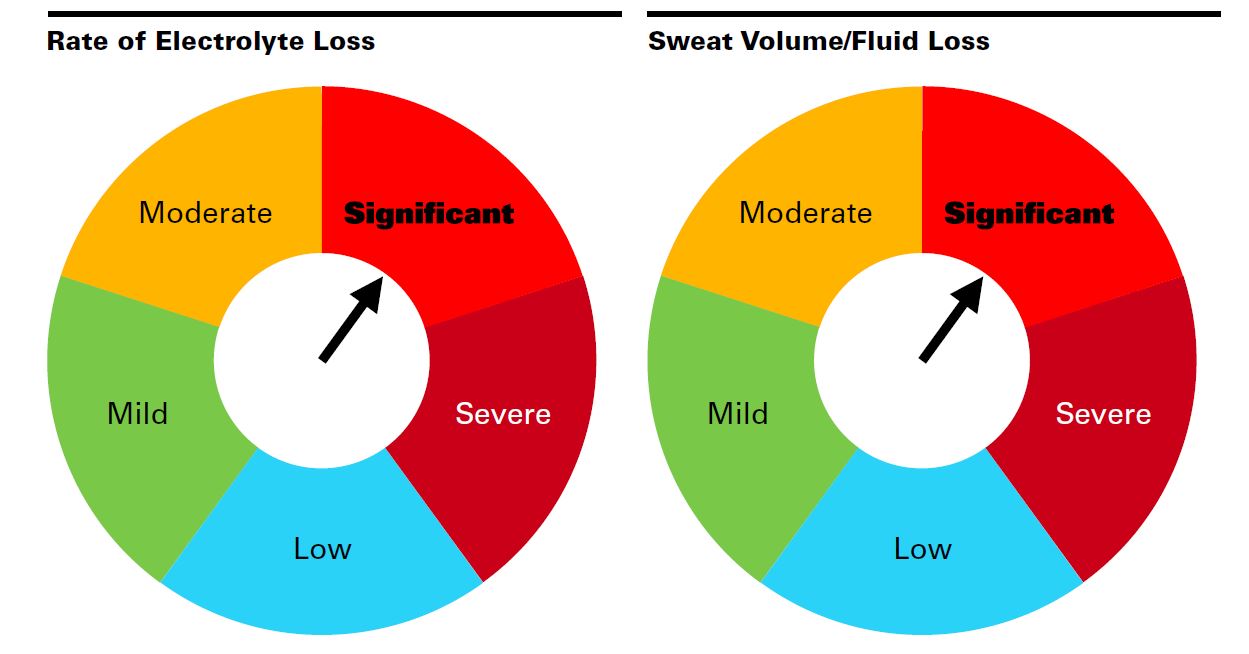
I was and wasn't happy to see these results. This does help explain why I keep ending up in the med tent, especially the significant electrolyte losses. This will definitely help me prepare for races, but losing a lot of fluid and electrolytes can definitely make long course races more challenging than they already are, especially hot races.
But now I have some real numbers to work with.
I lose:
- 53 mmol of sodium per liter of sweat
- 8.1 mmol of potassium per liter of sweat
- 51 mmol of chloride per liter of sweat
That comes to about 1200 mg of sodium per liter of sweat (34 oz). I've done a few sweat tests in the past and on hot days outdoors I tend to lose between 40-50 oz per hour. That's about 1400-1750 mg of sodium lost per hour.
They recommend replacing 60-70% of fluid and electrolytes lost. So I need to drink around 30-36 oz per hour and take in about 850-1200 mg of sodium per hour for a hot race. I'm probably getting about 300-400 mg of sodium per hour right now...maybe.
I asked them if electrolyte losses stay the same per liter of sweat lost regardless of sweat rate and they said yes, so now that I know how much I'm losing I can adjust my intake based on conditions and how much I think I'll sweat.
I got my results back about a week ago, so about 3 weeks before IMTX. It's a little late in the game to make changes, but what I'm currently doing isn't working so I'm taking a chance and more than doubling my electrolyte intake.
So I ordered a test from Levelen. A couple days later a package showed up in the mail containing my sweat test kit - an alcohol swab, cotton swab, a little plastic vile, tweezers and info card.
![]() |
| The cotton swab on my arm....ready to start sweating. |
You're supposed to replicate race conditions so I rode indoors and cranked the heat and humidity and got the temp up around 80 with 70% humidity. I didn't use a fan (mistake) because I wanted to make sure I'd sweat enough to get good results. I rode for an hour at Ironman power, but the heat, humidity and lack of a fan made for a pretty intense workout. I was burning up and ready for the hour to end so I could drink something and cool down.
As soon as I finished I used the tweezers to remove the swab and put it in the vile and I weighed myself. I had lost 3.8 pounds - 60 oz. Ouch.
I dropped everything in the mail the next day and a few days later they emailed results...
I was and wasn't happy to see these results. This does help explain why I keep ending up in the med tent, especially the significant electrolyte losses. This will definitely help me prepare for races, but losing a lot of fluid and electrolytes can definitely make long course races more challenging than they already are, especially hot races.
But now I have some real numbers to work with.
I lose:
- 53 mmol of sodium per liter of sweat
- 8.1 mmol of potassium per liter of sweat
- 51 mmol of chloride per liter of sweat
That comes to about 1200 mg of sodium per liter of sweat (34 oz). I've done a few sweat tests in the past and on hot days outdoors I tend to lose between 40-50 oz per hour. That's about 1400-1750 mg of sodium lost per hour.
They recommend replacing 60-70% of fluid and electrolytes lost. So I need to drink around 30-36 oz per hour and take in about 850-1200 mg of sodium per hour for a hot race. I'm probably getting about 300-400 mg of sodium per hour right now...maybe.
I asked them if electrolyte losses stay the same per liter of sweat lost regardless of sweat rate and they said yes, so now that I know how much I'm losing I can adjust my intake based on conditions and how much I think I'll sweat.
I got my results back about a week ago, so about 3 weeks before IMTX. It's a little late in the game to make changes, but what I'm currently doing isn't working so I'm taking a chance and more than doubling my electrolyte intake.
Subscribe to:
Posts (Atom)